Overview
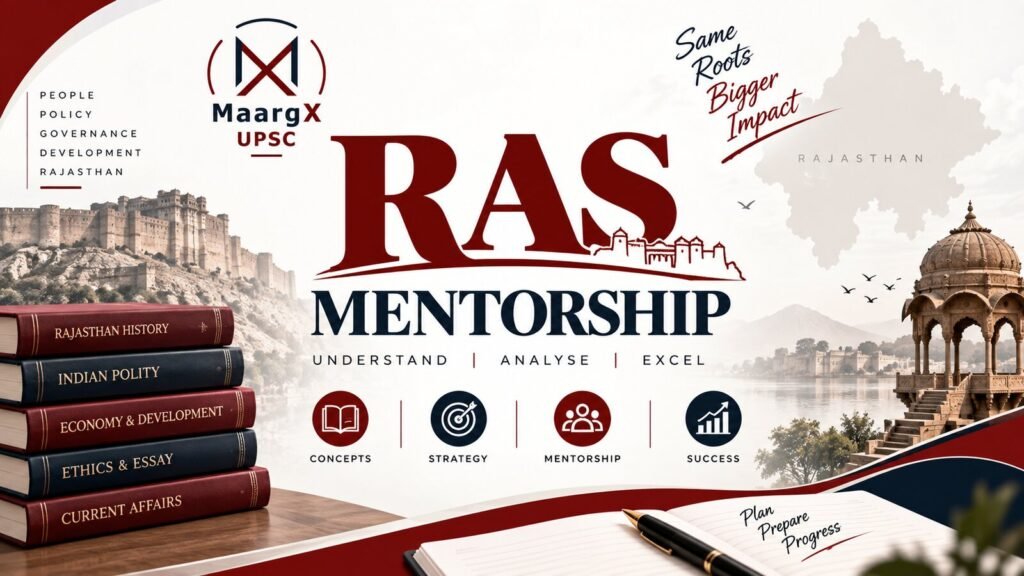
The MaargX RAS Mentorship is a 270-day micro-schedule for the Rajasthan Administrative Service: a 90-day Prelims Sprint followed by a 180-day Mains Marathon of 18 specialised phases. It runs on a daily answer-writing and cumulative-revision system, with Rajasthan-specific content built in at every stage.
Plan at a glance
| Detail | Phase I: Prelims Sprint | Phase II: Mains Marathon |
|---|---|---|
| Length | 90 days | 180 days, in 18 phases of 10 days |
| Focus | Objective mastery: broad-spectrum syllabus acquisition and daily MCQ practice | Subjective strength: depth, synthesis and answer engineering |
| Daily routine | Learn micro-topics and solve 50 MCQs on Days 1 to 6 of each week; revise the whole subject and solve 100 MCQs on Day 7 | An 8-hour daily flywheel: 3 hours study, 2 hours notes, 2 hours answer writing (DPP), 1 hour revision |
| Output | Three full-length 150-question mocks, error correction and final revision | 5 structured answers a day, and 20 answers a day in the final mock paper simulations |
Who it is for
This is a combined Prelims and Mains mentorship for RAS aspirants. It follows a fixed order: complete the subjects once, revise them in cycles, then simulate the exam.
Related courses and resources
For all-India civil services guidance, see the GS Prelims + Mains Mentorship, the GS Prelims Mentorship or the GS Mains Mentorship. For test practice, see the Prelims Test Series (GS & CSAT) and the GS Mains Test Series.
270-Day Timeline
Prelims Sprint
Phase I, the 90-Day Tactical Sprint, has three stages: core syllabus acquisition (Days 1 to 70), advanced integration (Days 71 to 85) and the Mock Crucible (Days 86 to 90).
| Days | Stage | What you do |
|---|---|---|
| Days 1 to 70 | Subject mastery and core syllabus acquisition | Sequential mastery of Rajasthan Special (history, culture, polity, economy), Indian history, geography, polity, economy, science, aptitude and current affairs, with micro-revision |
| Days 71 to 85 | Advanced integration (integrated revision) | Full-syllabus cross-linking, advanced revision, dedicated PYQ analysis and targeted removal of weak areas |
| Days 86 to 90 | The Mock Crucible (exam readiness) | Three complete 150-question full-length tests, intensive error correction and final rapid revision |
6+1 Cycle
The core engine of Phase I is the 6+1 cycle: six days of learning, then one day of consolidation, repeated exactly 10 times to complete Phase I's 70 days of subject work.
| Days | Mode | Task |
|---|---|---|
| Days 1 to 6 of each week | Learn | Master micro-topics and solve 50 MCQs daily |
| Day 7 of each week | Consolidate | Full subject revision and 100 MCQs |
Prelims Day-by-Day
The 70 days of subject work run in a fixed sequence, from Rajasthan and Indian history through geography, polity, economy and science, to aptitude and current affairs. The last day of each subject block is a 100-MCQ revision day.
| Days | Subject block | Coverage |
|---|---|---|
| Days 1 to 21 | History and Culture | Rajasthan (Days 1 to 14): history from prehistory to the 19th century, dynasties and resistance; culture including architecture, paintings, fairs, religion and performing arts. India (Days 15 to 21): ancient (Indus and Vedic, Maurya and Gupta), medieval (Delhi Sultanate, Mughals) and modern (British policies). Days 7, 14 and 21 are 100-MCQ revision days. |
| Days 22 to 28 | Geography funnel | World (Days 22 to 23): mountains, rivers, global climate. India (Days 24 to 25): physiography, agriculture, minerals. Rajasthan (Days 26 to 27): climate, soils, livestock. Day 28: full geography revision with 100 MCQs. |
| Days 29 to 42 | Dual polity focus | Centre (Days 29 to 35) and State (Days 36 to 42) studied as a 1-to-1 mapping: Preamble, Fundamental Rights and DPSP with foundational alignment; President with Governor; Parliament with Assembly; Supreme Court with High Court and local governance. State polity is studied as a mirror of the Centre. |
| Days 43 to 56 | Economy and Science and Technology (7 days each) | Economy: fiscal and monetary basics, RBI operations, LPG reforms, agriculture. Science and technology: physics and chemistry basics, biotech and genetics, space and IT, diseases and environment. |
| Days 57 to 70 | The scoring subjects | Aptitude (Days 57 to 63): logical reasoning, coding and decoding, data and graphs, arithmetic and probability. Current affairs (Days 64 to 70): national and state schemes, economy and budget, science and technology updates, sports and awards. |
Advanced revision matrix (Days 71 to 85)
Three five-day blocks: History + Geography (Days 71 to 75), Polity + Economy (Days 76 to 80) and Rajasthan Special (Days 81 to 85). Within each block you move from the full syllabus to advanced revision, then PYQ focus, weak areas and a final round.
The final polish (Days 86 to 90)
Full-length mocks 1, 2 and 3 (150 questions each, with deep analysis) on Days 86, 87 and 88. Day 89 targets weak areas through error-correction sets of 50 questions, and Day 90 is a final quick revision of all subjects with 50 questions.
Mains: 18 Phases
Phase II, the 180-Day Architectural Framework, has four pillars across 18 ten-day phases: core GS expansion (Phases 1 to 15), consolidation (Phase 16), answer engineering (Phase 17) and the final simulation (Phase 18). Every phase ends with output, not only input.
| Phase | Days | Subject | What it covers |
|---|---|---|---|
| 1 | 1 to 10 | Rajasthan history | Foundation from prehistory to the Guhilas, Mughal-Rajput relations and integration. Output: dynastic and movement analysis. |
| 2 | 11 to 20 | Rajasthan culture | Temple and fort architecture, Bhakti saints, tribal lifestyles and tourism. Output: cultural synthesis answers. |
| 3 | 21 to 30 | Indian history | From the Indus Valley and Vedic society through Mauryan and Gupta administration to the freedom struggle. Output: administrative and colonial impact answers. |
| 4 | 31 to 40 | World history | From the Renaissance and Reformation through the World Wars to the Cold War and the UNO. Output: event cause-and-effect analysis. |
| 5 | 41 to 50 | Economy basics | GDP, RBI and budgets; MSMEs and types of inflation; an overview of the Rajasthan economy. Output: defining and explaining economic concepts. |
| 6 | 51 to 60 | Economy, advanced integration | LPG reforms, balance of payments, WTO and NITI Aayog; NPAs, FRBM deficits, inclusive growth and poverty; Rajasthan industrial corridors, subsidies and flagship schemes. Output: critiquing schemes, evaluating fiscal discipline and analysing budget trends. |
| 7 | 61 to 70 | Ethics: theory and thinkers | Human values, emotional intelligence, probity and the philosophies of Gandhi and Vivekananda. Output: thinker-based answers and definitions. |
| 8 | 71 to 80 | Ethics: case study mastery | Applying theory to social issues, conflict resolution, leadership dilemmas and integrity crises, through the administrative crucible of transparency, accountability and work ethics. Output: full case study simulation answers. |
| 9 | 81 to 90 | Science and technology | A highly applied phase, from everyday physics to biotech, AI, cyber security, space (ISRO) and climate change. |
| 10 | 91 to 100 | World and India geography | Systems and hazards: climatology (monsoons), oceanography, Indian physiography, agriculture patterns and disaster management. |
| 11 | 101 to 110 | Rajasthan geography | State resource management: the Aravalli, desert ecology, water and irrigation, soils, minerals and industrial and transport infrastructure. |
| 12 | 111 to 120 | Polity (the rules) | The Constitution, Fundamental Rights, judiciary (SC/HC review), federalism and amendments. |
| 13 | 121 to 130 | Governance (the interface) | Good governance indicators, e-governance, RTI, citizen charters, NGOs and SHGs, and policy formulation. |
| 14 | 131 to 140 | Public administration (the engine) | Thinkers (Wilson, Weber), HR management, financial administration (budgets and CAG), development administration and the role of the District Collector. |
| 15 | 141 to 150 | Psychology and law (the human element) | Personality theories, learning models, motivation (Maslow, Herzberg), stress management and leadership styles; core legal concepts, human rights frameworks, crucial Acts and current legal issues. |
| 16 | 151 to 160 | GS consolidation (interlinking) | Days 151 to 156 target weak areas across history and culture, ethics, science and geography, and polity and governance. Days 157 to 160 are mixed revision and PYQ integration. |
| 17 | 161 to 170 | Answer engineering | Day 161 structure (intro, body, conclusion); Day 162 content enrichment (hard data, constitutional articles, live examples); Day 163 diagram practice (flowcharts, hub-and-spoke models); Days 164 to 170 execution (speed writing, time management, mentor evaluation against model answers). |
| 18 | 171 to 180 | Final simulation | See the Final Simulation tab. |
Day ranges for Phases 5 to 15 follow from the plan's 10-day structure.
8-Hour Flywheel
The 8-hour productivity flywheel is the fixed daily routine of the Mains Marathon: 3 hours of study, 2 hours of notes, 2 hours of answer writing and 1 hour of revision. The ratio stays the same on every one of the 180 days.
| Hours | Activity | Purpose |
|---|---|---|
| 3 hours | Study (input) | Acquiring core concepts and digesting source material |
| 2 hours | Notes (consolidation) | Distilling vast reading into ultra-condensed, exam-ready formats |
| 2 hours | DPP (output) | Writing 5 structured subjective answers daily, to turn knowledge into marks |
| 1 hour | Revision (retention) | Cumulative recall to lock in the previous days' learning |
Why daily output
The plan's core idea is that input without output is an illusion of progress. Writing 5 answers a day for 180 days means 900 answers written before the exam.
Revision Cascade
The Cumulative Revision Cascade makes the one-hour revision slot cover every day of the phase so far, not just the latest topic. On Day 4 you revise Days 1, 2, 3 and 4, not Day 4 alone.
| Question | Answer |
|---|---|
| The problem | Traditional reading leaves earlier topics forgotten by Day 180 |
| The MAARG solution | The daily one-hour revision slot forces cumulative recall |
| The result | By Day 10 of any phase, the Day 1 material has been reviewed 10 separate times |
Final Simulation
Phase 18, the Final Simulation, has four stages across Days 171 to 180: the Gauntlet, Eradication, Consolidation and a Day 180 flash revision.
| Days | Stage | What you do |
|---|---|---|
| Days 171 to 173 | The Gauntlet | Full mock test paper simulations for three GS papers, writing 20 answers a day under strict exam conditions |
| Days 174 to 176 | Eradication | Deep answer review, hunting down and eliminating the final weak areas across all three papers |
| Days 177 to 179 | Consolidation | Rapid, ultra-condensed notes review for the three GS papers |
| Day 180 | Flash revision | High-speed mental recall of all GS frameworks |
Frequently Asked Questions
What is the MaargX RAS Mentorship?
It is a 270-day micro-schedule for the Rajasthan Administrative Service. A 90-day Prelims Sprint is followed by a 180-day Mains Marathon of 18 phases, with daily answer writing and cumulative revision.
How is the 270-day plan divided?
Phase I is the 90-day Prelims Sprint and Phase II is the 180-day Mains Marathon. Together they make up the 270 days, the same as the 9-month duration of the course.
What is the 6+1 cycle?
In Phase I, you learn micro-topics and solve 50 MCQs a day on Days 1 to 6, then revise the whole subject and solve 100 MCQs on Day 7. The cycle repeats exactly 10 times to complete the 70 days of subject work.
What are the three stages of the Prelims Sprint?
Days 1 to 70 are core syllabus acquisition, Days 71 to 85 are advanced integration with PYQ analysis, and Days 86 to 90 are the Mock Crucible with three full-length 150-question tests and error correction.
Which subjects does the plan cover?
It covers Rajasthan history, culture, geography, economy and polity, plus Indian and world history, ethics, science and technology, polity, governance, public administration, psychology and law, with aptitude and current affairs in the Prelims phase.
What is the 8-hour daily flywheel?
In the Mains Marathon, each day has 3 hours of study, 2 hours of notes, 2 hours of answer writing and 1 hour of revision. The ratio is kept the same for all 180 days.
How many answers will I write?
The Mains Marathon has 5 structured answers a day for 180 days, which is 900 answers. In the final simulation you write 20 answers a day under strict exam conditions.
What is the Cumulative Revision Cascade?
The daily one-hour revision covers all days of the phase so far, so by Day 10 of a phase the Day 1 material has been reviewed 10 separate times.
What happens in the last 10 days?
Days 171 to 173 are full mock paper simulations, Days 174 to 176 eliminate the final weak areas, Days 177 to 179 are a rapid notes review, and Day 180 is a flash revision of all frameworks.
How can I enrol?
Use the Explore Course / Enroll Now button at the top of this page, or call MaargX UPSC on +91-7877885089 or write to contact@maargxupsc.com.