Overview
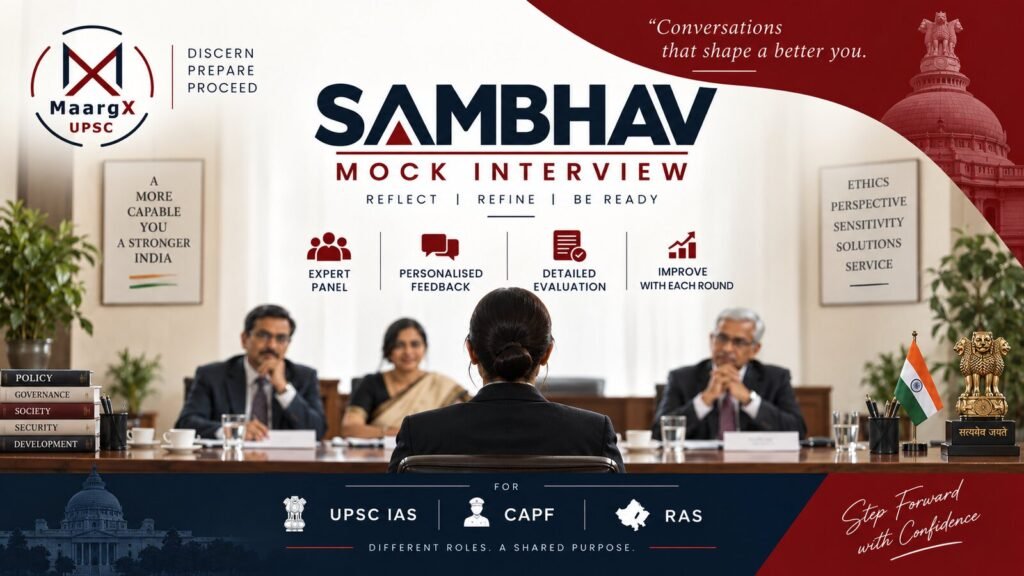
SAMBHAV is MaargX UPSC's mock interview programme: a simulation of the UPSC Personality Test, the final stage of the Civil Services Examination. It is a one-time interview that lets you experience the real format before you face it.
The Personality Test is not a test of memory. It looks at how you think, how you present yourself and how you handle questions about your own background, your views and the issues around you. A mock interview lets you practise exactly that, in a setting that feels like the real one.
Programme at a glance
| Detail | What you get |
|---|---|
| Programme | SAMBHAV Mock Interview, a UPSC Personality Test simulation |
| Format | One-time interview, booked through a short form |
| Who it is for | Aspirants preparing for an interview: UPSC CSE, CAPF, UGC NET or EPFO |
| Focus | Practising the interview experience: answering, presenting yourself and handling questions |
How booking works
- Press Explore Course / Enroll Now at the top of this page.
- Enter your name, your mobile number and the interview you are preparing for: UPSC CSE, CAPF, UGC NET or EPFO.
- Our team gets back to you with the available slots, and your confirmed date and time are sent to you on WhatsApp.
For any question, call MaargX UPSC on +91-7877885089 or write to contact@maargxupsc.com.
Related courses and resources
For guidance across the whole exam, see the GS Prelims + Mains Mentorship. For Mains preparation, see the GS Mains Mentorship or the GS Mains Test Series. You can also follow MaargX UPSC's daily UPSC current affairs articles, which help with questions on recent events.
Personality Test
The UPSC Personality Test is the interview stage of the Civil Services Examination, where a board talks to the candidate about their background, views and awareness. It is the last step before the final result.
What the board looks at
The interview is a conversation, not an oral exam. The board is trying to understand the person behind the application: clarity of thought, balance of judgement, honesty and the ability to explain a view calmly.
Why practise with a mock interview
- You meet the format before the real day, so the setting feels familiar.
- You find out how your answers sound when spoken, not only when written.
- You discover which questions make you hesitate, and can work on them.
- You practise staying composed when a question is unexpected.
Question Areas
Interview questions usually come from a few predictable areas: your own profile in the Detailed Application Form (DAF), your education and optional subject, your home state and city, current affairs, and your opinions on public issues. Preparing these areas in advance is the core of interview preparation.
| Area | What to prepare |
|---|---|
| Your DAF | The Detailed Application Form is the UPSC document the board has in front of it. Be ready to explain every line you have written, including your hobbies and achievements |
| Education and optional subject | Your degree, your college and your optional subject: be able to discuss them with understanding, not only with facts |
| Home state and city | Its geography, history, culture, economy, famous places and issues |
| Work and background | If you have worked, be ready to explain your role, what you learned and why you want a career in the civil services |
| Current affairs | Recent national and international developments and the arguments on different sides |
| Opinions and situations | Questions that ask for your view on a public issue or how you would act in a situation, where reasoning matters more than a fixed answer |
| Service preferences | Why you chose your service and cadre preferences, and what you would like to do in the service |
Interview Guidelines
The UPSC Personality Test (interview) carries 275 marks and is a conversation with a Board of impartial observers, not an oral exam. These guidelines follow what UPSC publishes about the Personality Test, plus practical advice from MaargX UPSC. Always check your own e-Summon Letter and UPSC's latest notice, because they decide the final instructions for your interview.
What UPSC says about the Personality Test
| Point | What it means |
|---|---|
| Purpose | To assess a candidate's personal suitability for a career in public service |
| Who assesses | A Board of competent and impartial observers who have a record of the candidate's career |
| Style | A natural, directed and purposeful conversation, not a strict cross-examination |
| Focus | General awareness and the candidate's mental qualities, not specialised or technical knowledge |
| Marks | 275 |
Qualities the Board looks for
- Mental alertness
- Critical powers of assimilation
- Clear and logical exposition
- Balance of judgement
- Variety and depth of interest
- Ability for social cohesion and leadership
- Intellectual and moral integrity
UPSC also expects an intelligent interest in your own academic subjects and in current events within and outside your state and country.
Official procedure to follow
| Step | What to do |
|---|---|
| e-Summon Letter | Download it from the UPSC websites (upsc.gov.in and upsconline.in). UPSC does not send paper summons for the Personality Test. If you cannot download it, write to UPSC at once at csm-upsc@nic.in |
| DAF-II | Fill and submit the Detailed Application Form-II online. Without it your candidature stands cancelled and no e-Summon Letter is issued. UPSC does not allow changes to DAF-I or DAF-II afterwards |
| Original documents | Carry the originals of the certificates that support your claims: age, educational qualifications, community or EWS and PwBD status where applicable, along with the TA Form |
| Date, session and venue | They are printed on your e-Summon Letter. Read it carefully and plan your travel in advance |
On the day: practical guidelines
- Reach early. Arrive well before your reporting time, with all documents in one folder.
- Dress simply and formally. Choose clean, comfortable, formal clothes you feel confident in. UPSC's notices do not ask for any particular style.
- Greet the Board and wait to be seated. Speak politely and keep a calm, natural posture.
- Listen to the full question. Pause, then answer directly in a few clear sentences.
- Be honest. If you do not know, say so calmly. Do not guess or bluff.
- Stay balanced on opinions. Give reasons, acknowledge other views and avoid extreme positions.
- Know your DAF. Everything you wrote can be asked about, including hobbies and service preferences.
- Thank the Board when the interview ends and leave calmly, whatever the interview felt like.
Before the interview
- Revise your DAF line by line and prepare short answers about your education, optional subject, home state, work and hobbies.
- Read national and international current affairs daily.
- Practise answering aloud, and take a mock interview to experience the format.
The same approach helps for other interviews as well, such as CAPF, UGC NET and EPFO, but each exam has its own rules, so read the instructions given for your exam.
Sources
UPSC Civil Services Examination notice and UPSC press notes on the Personality Test, available at upsc.gov.in.
How to Prepare
Good interview preparation is practice: speak your answers aloud, listen to them and improve them. A mock interview is one form of that practice.
How to get more from a mock interview
- Prepare your DAF first. Go through each line and write down what you could be asked about it.
- Answer in your own words. A natural, honest answer works better than a memorised one.
- Be balanced on opinions. Give reasons and show that you understand more than one side of an issue.
- It is fine not to know. If you do not know something, say so calmly instead of guessing.
- Review afterwards. Write down what went well and what to improve before your next practice.
Link your preparation with current affairs
Questions on recent events are common, so read daily. MaargX UPSC's current affairs articles explain recent developments with key issues and implications.
Frequently Asked Questions
How many marks is the UPSC interview?
The UPSC Civil Services Personality Test (interview) carries 275 marks.
What does the UPSC interview board assess?
UPSC says the Board assesses personal suitability for a career in public service. The qualities include mental alertness, critical powers of assimilation, clear and logical exposition, balance of judgement, variety and depth of interest, ability for social cohesion and leadership, and intellectual and moral integrity.
What documents are needed for the UPSC interview?
Your e-Summon Letter, which you download from the UPSC website, and the original certificates that support your claims, such as age, educational qualifications, community or EWS and PwBD status where applicable, along with the TA Form. Submit DAF-II online before the deadline.
Does UPSC send a paper summons for the interview?
No. UPSC makes e-Summon Letters available on its websites, and does not issue paper Summon Letters for the Personality Test.
What should I wear to the UPSC interview?
UPSC's notices do not ask for a particular style. Choose clean, comfortable and formal clothes in which you feel confident.
What is the SAMBHAV Mock Interview?
SAMBHAV is MaargX UPSC's mock interview programme: a simulation of the UPSC Personality Test, the final stage of the Civil Services Examination. It is a one-time interview.
What is the UPSC Personality Test?
The Personality Test is the interview stage of the Civil Services Examination. A board talks to the candidate about their background, views and awareness, to understand how they think and present themselves.
Who should take the mock interview?
Aspirants who are preparing for, or have qualified for, the UPSC Personality Test and want to experience the format before the real interview.
How do I book a slot?
Press Explore Course / Enroll Now at the top of this page and fill in your name, mobile number and the interview you are preparing for (UPSC CSE, CAPF, UGC NET or EPFO). Our team gets back to you with the available slots and sends your confirmed date and time on WhatsApp.
What is the DAF and why does it matter?
The DAF is the Detailed Application Form submitted to UPSC. The interview board has it in front of them, so questions often come from what you have written about your education, hobbies, background and preferences. Be ready to explain every line.
What kinds of questions are asked in the interview?
Questions commonly come from your DAF, your education and optional subject, your home state and city, current affairs and your opinions on public issues or situations.
How should I prepare for the Personality Test?
Prepare your DAF line by line, practise answering aloud in your own words, stay balanced on opinions, read current affairs daily and review each practice session to improve the next.
Does a mock interview guarantee success in the real interview?
No. A mock interview is practice. It helps you become familiar with the format and improve your answers, but the real outcome depends on your own preparation and performance.
Which interviews can I take a mock for?
You can choose UPSC CSE, CAPF, UGC NET or EPFO in the booking form. For other questions, call MaargX UPSC on +91-7877885089 or write to contact@maargxupsc.com.