Overview
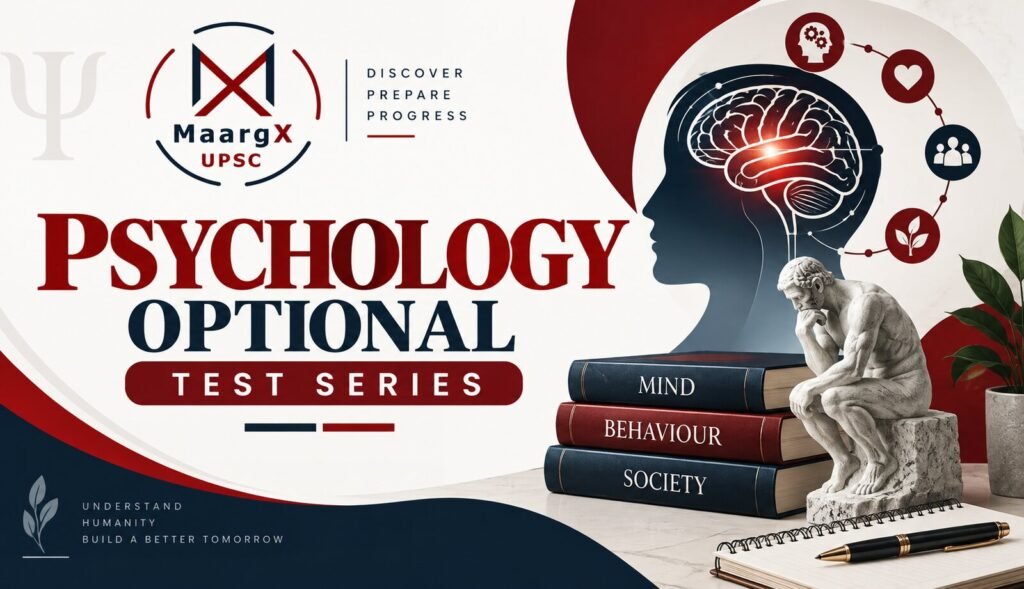
The MaargX Psychology Optional Test Series (SAATHI) is a comprehensive 12-test programme for UPSC Psychology: 8 sectional tests across Paper 1 and Paper 2, then 4 full-length tests, with personalised Micro-Mentoring and flexible scheduling. It gives equal focus to both papers.
Course at a glance
| Detail | What you get |
|---|---|
| Total tests | 12: 8 sectional tests (Tests 1 to 8) and 4 full-length tests (Tests 9 to 12) |
| Paper 1 | Foundations: core psychological mechanisms (Tests 1 to 4) |
| Paper 2 | Applications and issues: real-world applications (Tests 5 to 8) |
| Full-length tests | Tests 9 and 11 on Paper 1, Tests 10 and 12 on Paper 2, simulating exact UPSC conditions |
| Mentoring | Weekly one-on-one P2P sessions with expert faculty using the 5 I approach |
| Scheduling | Flexible dates: tests can be postponed to suit your schedule |
| Mode | Online and offline |
The SAATHI advantage
- Personalised Micro-Mentoring: weekly P2P sessions using a unique 5 I approach for in-depth analysis.
- Flexible date management: candidates can postpone tests to accommodate their schedules.
- The Examable approach: learning limited to specific examination needs and high-yield topics.
Related courses and resources
For another optional-subject series, see the Philosophy Optional Test Series, the Anthropology Optional Test Series or the Sociology Optional Test Series. For General Studies practice, see the GS Mains Test Series.
Test Schedule
Paper 1 vs Paper 2
Paper 1 covers the core psychological mechanisms, and Paper 2 covers their real-world applications. A strong candidate does not memorise two papers; they use Paper 1 to diagnose the problems presented in Paper 2.
| Paper 1: Core psychological mechanisms (Tests 1 to 4) | Paper 2: Real-world applications (Tests 5 to 8) | |
|---|---|---|
| Focus | Biological substrates, cognitive architectures and theoretical frameworks | Implementing psychological principles to solve clinical, societal and organisational challenges |
| Key domains | Memory, learning, personality, research methodologies | Therapy, organisational behaviour, community rehabilitation, IT and media |
| Thinking style required | Empirical, structural, diagnostic | Applied, interventional, sociological |
Paper 1 Tests
The four Paper 1 sectional tests move from research foundations to cognition, personality and modern perspectives.
| Test | Theme | Coverage |
|---|---|---|
| Test 1 | Foundations and Scientific Methodologies | Definition, historical antecedents and 21st-century trends; psychology's relation to other sciences and societal problems; methods (descriptive, evaluative, diagnostic, prognostic; survey, observation, case study, experiments, quasi-experimental designs, FGD, brainstorming, grounded theory); research steps from problem statement to report writing; research designs and statistics (ex-post facto, experimental, t-test, two-way ANOVA, correlation, regression, factor analysis, item response theory) |
| Test 2 | Development, Senses and the Architecture of Learning | Human behaviour development (growth principles, genetic and environmental factors, cultural socialisation, life-span tasks, well-being); sensation, attention and perception (thresholds, signal detection, vigilance, perceptual organisation, ESP, subliminal perception); learning theories (behaviourists, Gestaltists, information processing, reinforcement schedules, modelling and social learning) |
| Test 3 | Cognition, Emotion and Intelligence | Memory systems (STM/LTM, multistore model, levels of processing, forgetting theories, amnesia); thinking and problem solving (Piaget, concept formation, creative thinking, decision making); motivation and emotion; intelligence and aptitude (Spearman, Thurstone, Guilford, Vernon, Sternberg, J.P. Das; emotional and social intelligence; IQ; fluid versus crystallised intelligence) |
| Test 4 | Identity, Communication and Modern Perspectives | Personality architecture (psychoanalytical, socio-cultural, humanistic, behaviouristic, trait and type approaches; projective and pencil-paper tests; Indian approach; Big 5; notion of self); attitudes, values and interests; language and communication (Skinner and Chomsky); modern contemporary issues (AI, psych cybernetics, sleep-wake schedules, dreams, meditation, hypnotic states, simulation studies) |
Paper 2 Tests
The four Paper 2 sectional tests cover clinical and organisational psychology, education and community systems, society and technology, and specialised applications.
| Test | Theme | Coverage |
|---|---|---|
| Test 5 | Clinical Measurement, Therapy and Organisational Behaviour | Individual differences (standardisation of tests; use, misuse, limitations and ethics of testing); well-being and mental disorders (anxiety, mood, schizophrenia, personality and substance abuse disorders); therapeutic interventions (psychodynamic, behaviour, client-centred, cognitive; indigenous therapies such as yoga and meditation; biofeedback; rehabilitation); work psychology and organisational behaviour (personnel selection; Herzberg, Maslow, Adam's Equity, Porter and Lawler, Vroom; leadership; stress management; ergonomics; transformational leadership) |
| Test 6 | Education, Community and Rehabilitation Systems | Educational field (teaching-learning principles, learning styles, interventions for gifted, retarded and learning-disabled students, value education, career counselling); community psychology (small groups in social action, community consciousness, group decision making and leadership); rehabilitation psychology (primary, secondary and tertiary prevention; services for the physically and mentally challenged, old persons, substance abuse, juvenile delinquency, victims of violence and HIV/AIDS; role of social agencies) |
| Test 7 | Society, Technology and Economic Development | Economic development (achievement motivation, entrepreneurship among youth and women, consumer rights); IT and mass media (consequences of the IT boom, distance learning, e-commerce entrepreneurship, TV impact, fostering values through media); social integration (caste, class, religion and language conflicts; in-group versus out-group prejudice; conflict resolution); disadvantaged groups (consequences of deprivation, educating and motivating towards development) |
| Test 8 | Environment, Gender and Specialised Applications | Environmental and population psychology (noise, pollution, crowding, population explosion, small family norms); psychology of gender (discrimination, diversity management, glass ceiling, self-fulfilling prophecy, women in Indian society); military and terrorism (psychological tests for defence selection, human engineering, psychology of terrorism); sports and media (interventions for athletes, media influences on pro- and anti-social behaviour) |
Full-Length Tests
The Culmination, Full-Length Synthesis, has four tests designed to simulate exact UPSC conditions: two on the full Paper 1 and two on the full Paper 2. This is where theory translates into application and isolated concepts merge into multi-dimensional answers.
| Test | Paper | Format |
|---|---|---|
| Test 9 | Paper 1 | Full length, flexible date |
| Test 10 | Paper 2 | Full length, flexible date |
| Test 11 | Paper 1 | Full length, flexible date |
| Test 12 | Paper 2 | Full length, flexible date |
Mentoring Loop
The SAATHI Micro-Mentoring loop turns each test into a cycle of testing, analysis, mentoring and note-making, all built around a personalised strategy.
- Examable approach testing: rigorous testing, available in online and offline modes.
- Detailed analysis and evaluation: personalised evaluation identifying exact knowledge gaps.
- P2P mentoring sessions: personalised weekly one-on-one sessions with expert faculty.
- The 5 I Micro-Mentoring: topic-wise hand-holding and note-making based on the unique 5 I approach.
The centre of the loop is a personalised strategy, tailored to your individual needs and availability.
Flexibility
Schedules are adaptive: you can postpone your test as per your convenience, so you can master the material at your own pace. Preponing is not permitted, to ensure analytical depth.
| If you need | What happens |
|---|---|
| A later date | Postponing a test is permitted, according to your convenience |
| An earlier date | Preponing is not permitted, to ensure analytical depth |
Frequently Asked Questions
What is the MaargX Psychology Optional Test Series?
It is a comprehensive 12-test UPSC Psychology optional series called SAATHI. It has 8 sectional tests across Paper 1 and Paper 2, then 4 full-length tests, with personalised Micro-Mentoring and flexible scheduling.
How are the 12 tests divided?
Tests 1 to 4 are sectional tests on Paper 1 (foundations), Tests 5 to 8 are sectional tests on Paper 2 (applications), and Tests 9 to 12 are full-length tests: Tests 9 and 11 on Paper 1, Tests 10 and 12 on Paper 2.
What does Paper 1 cover in the series?
Test 1 covers methods, research and statistics, Test 2 covers development, perception and learning, Test 3 covers memory, thinking, motivation, emotion and intelligence, and Test 4 covers personality, attitudes, language, communication and modern contemporary issues.
What does Paper 2 cover in the series?
Test 5 covers clinical measurement, mental disorders, therapy and organisational behaviour. Test 6 covers education, community and rehabilitation psychology. Test 7 covers economic development, IT and media, social integration and disadvantaged groups. Test 8 covers environment, gender, military, terrorism, sports and media.
How are Paper 1 and Paper 2 linked?
A master candidate does not memorise two papers; they use Paper 1 to diagnose the problems presented in Paper 2. The full-length tests bring both papers together under UPSC-like conditions.
What is the 5 I Micro-Mentoring approach?
It is MaargX's approach of topic-wise hand-holding, in-depth analysis and note-making, delivered through weekly one-on-one P2P sessions with expert faculty.
Can I postpone or prepone a test?
You can postpone a test according to your convenience. Preponing is not permitted, to ensure analytical depth.
Is the series available online and offline?
Yes. The testing is available in both online and offline modes.
What is the Examable approach?
It limits learning paradigms to specific examination needs and high-yield topics, so preparation stays focused on what the UPSC asks.
How can I enrol?
Use the Explore Course / Enroll Now button at the top of this page, or call MaargX UPSC on +91-7877885089 or write to contact@maargxupsc.com.