Overview
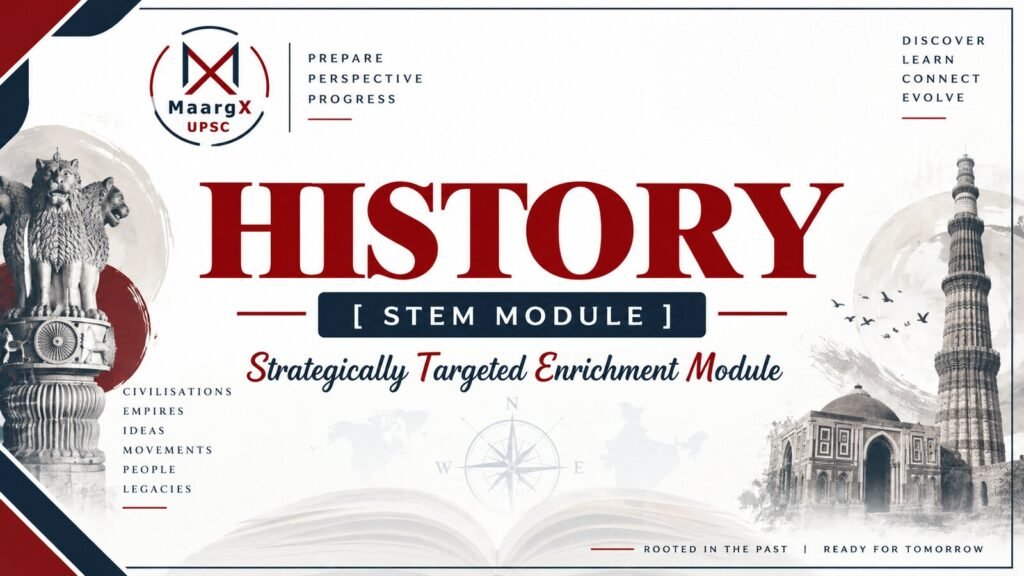
The MaargX History Module is a subject-wise UPSC course that covers Indian and world history for the UPSC syllabus, from the earliest civilisations to the post-independence period and the major events of the world. It is a focused module: topic-wise lectures, with Daily Practice Papers (DPPs) to practise what you learn.
This module covers Prelims General Studies Paper I (History) and Mains GS-I.
Module at a glance
| Detail | What you get |
|---|---|
| Subject | History |
| What you get | Lectures on the subject, with Daily Practice Papers (DPPs) |
| Practice | DPPs: unit-wise question sets that cover the subject syllabus |
| UPSC papers | Prelims General Studies Paper I (History) and Mains GS-I |
| Not part of this module | Mentorship and tests (see the related courses below if you need them) |
Who it is for
This module suits UPSC aspirants who want to study History as a separate subject, in the order the syllabus follows, and who prefer to add mentoring or tests only when they need them.
Related courses and resources
You can pair this module with Geography Module, Society Module or the GS Foundation Course (1 Year). If you want tests, see the Prelims Test Series (GS & CSAT) or the GS Mains Test Series, and for personal guidance the GS Prelims + Mains Mentorship. You can also follow MaargX UPSC's daily UPSC current affairs articles.
Syllabus
The History Module follows the UPSC syllabus for the subject, in 5 blocks. The table lists the topic areas each block covers.
| Block | Topics covered |
|---|---|
| Ancient India | Indus Valley civilisation, Vedic age, Mahajanapadas, Mauryan and Gupta empires, post-Gupta kingdoms, South Indian dynasties, religious movements and ancient society |
| Medieval India | Early medieval states, Delhi Sultanate, Mughal empire, Vijayanagara and regional kingdoms, Bhakti and Sufi movements, medieval society, economy and administration |
| Modern India | Advent of Europeans and British expansion, economic impact of colonial rule, the Revolt of 1857, social and religious reform movements, the national movement and the Gandhian phase, independence and partition |
| Post-independence India | Consolidation of the nation: integration of princely states, reorganisation of states, and the major developments after independence |
| World history | The Industrial Revolution, the World Wars, colonisation and decolonisation, political philosophies such as communism, capitalism and socialism, and their effects on society |
Lectures + DPP
The module has two parts: lectures that teach the subject, and Daily Practice Papers (DPPs) that help you practise it. Nothing else is bundled, so the module stays simple and focused.
1. Lectures
Topic-wise lectures on History, following the blocks in the Syllabus tab.
2. Daily Practice Papers (DPPs)
A DPP is a unit-wise question set that covers the subject and fits your study schedule. DPPs have four objectives:
- Strengthen conceptual understanding.
- Improve retention of topics.
- Practise applying knowledge in exam-oriented questions.
- Develop analytical thinking.
What is not included
This module does not include mentorship or tests. To add them, see the GS Prelims + Mains Mentorship, the Prelims Test Series (GS & CSAT) and the GS Mains Test Series.
Frequently Asked Questions
What is the MaargX History Module?
It is a subject-wise UPSC course on History. It gives you topic-wise lectures with Daily Practice Papers (DPPs). It does not include mentorship or tests.
What does the History Module cover?
It covers the UPSC syllabus areas for History: ancient india, medieval india, modern india, post-independence india, world history.
Which UPSC papers does it prepare me for?
It covers Prelims General Studies Paper I (History) and Mains GS-I.
What are DPPs?
DPPs are Daily Practice Papers: unit-wise question sets that cover the subject and fit your study schedule. They strengthen concepts, improve retention, build exam-oriented application and develop analytical thinking.
Does the module include mentorship or tests?
No. The module has lectures and DPPs only. If you want mentoring or tests, you can add the GS Prelims + Mains Mentorship, the Prelims Test Series or the GS Mains Test Series.
How long is the module and what does it cost?
The duration and the fee are shown at the top of this page.
Who should take the History Module?
UPSC aspirants who want to study History as a separate subject and prefer a focused course of lectures and practice papers.
How can I enrol?
Use the Explore Course / Enroll Now button at the top of this page, or call MaargX UPSC on +91-7877885089 or write to contact@maargxupsc.com.